

If you run EV charging stations long enough, this moment is inevitable. You open your charging dashboard, everything looks fine … and then you spot it. One charger. Maybe three. Maybe half the site. All marked offline. Drivers can’t charge. Support tickets start piling up. Someone asks, “Is the charger broken?”
Most of the time, the answer is: nope. An offline charger usually isn’t broken. It’s just not talking to your system. And once you understand why that happens, fixing it – and preventing it – gets much easier. Let’s walk through it together, calmly and clearly.
When an EV charger is offline, it means the charger has stopped communicating with the charging management system (sometimes called a CMS or CSMS). That’s the software platform operators use to monitor charger status, uptime, charging sessions, and payments.
In plain English: The charger might still have power, but your system can’t see or hear it anymore.
This loss of communication usually happens because of:
Offline does not automatically mean unusable. Some chargers can still allow local charging even when they’re offline – operators just can’t monitor or control them remotely.
These two terms get mixed up all the time, and that confusion causes bad decisions.
If a charger is offline, the problem is usually communication-related. If it’s out of service, the charger knows something is wrong. Mixing these up can lead to unnecessary site visits – or worse, ignoring a real safety issue.
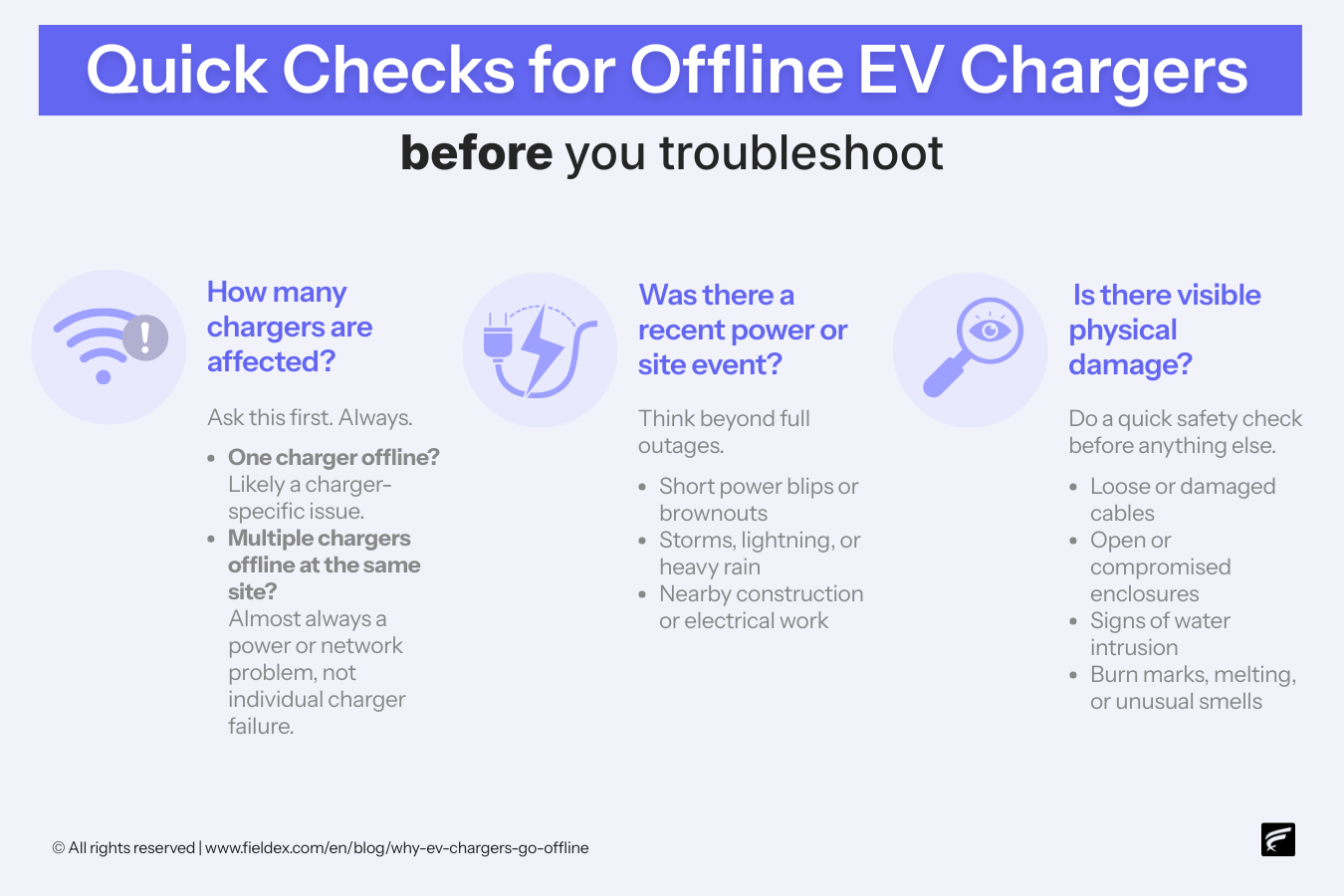
Before touching anything, take a breath and gather context. These quick checks often point you in the right direction immediately.
This context saves time and prevents guesswork.
While every site is different, most offline incidents fall into a handful of repeat patterns. Once you recognize them, troubleshooting becomes far less stressful. Let’s walk through the most common causes.
Power issues are the #1 cause of offline chargers. Even a short power blip – something drivers barely notice – can:
According to the US Department of Energy, power quality issues are a leading contributor to EVSE (Electric Vehicle Supply Equipment) reliability problems.
If your charger relies on Ethernet, Wi-Fi, or cellular connectivity, the weakest link is often not the charger – it’s the network.
The National Renewable Energy Laboratory (NREL) has repeatedly flagged site networking as a key reliability risk for public chargers.
Many DC fast chargers rely on cellular connections because running fiber or Ethernet everywhere isn’t practical.
This one causes a lot of head-scratching. OCPP communication often uses WebSockets (basically a persistent two-way connection). Some firewalls or routers quietly close idle connections after a set time.
Open Charge Alliance documentation highlights heartbeat and keepalive settings as critical for connection stability.
Sometimes the charger is fine. The network is fine. But the backend configuration isn’t.
When a charger boots, it sends a BootNotification – basically saying, “Hi, I’m here". If the backend rejects it, the charger stays offline (Open Charge Alliance).
Chargers are computers. Computers run software. Software sometimes misbehaves. A failed firmware update can:
NREL has documented firmware stability as a major factor in charger reliability.
Sometimes the answer really is physical. Common issues include:
Environmental exposure is a known reliability challenge for outdoor chargers (US DOE).
Power issues are the most common cause of offline chargers – and often the least obvious.
The charger may power back on, but the router doesn’t. From the operator’s perspective, the charger suddenly “vanishes".
Very often, the charger is fine – the network isn’t.
If the network path breaks anywhere between the charger and the backend, the charger goes offline – even if it’s physically healthy.
Most modern chargers communicate using OCPP (Open Charge Point Protocol). It’s a standard language chargers and backend systems use to talk to each other.
You don’t need to be a software engineer to troubleshoot this. You just need to know which messages should be flowing – and when they stop.
Many offline issues can be resolved without sending anyone on-site.
If the charger comes back online after these steps, you’ve saved time, money, and a truck roll.
Some problems can’t be solved from behind a screen.
Knowing when not to dispatch is just as important as knowing when to do it.
Here’s the honest truth: Most offline incidents aren’t random. They’re process problems.
When these pieces are in place, offline events become easier to fix – and happen less often.
When charger checks, network inspections, firmware updates, and incident follow-ups live in spreadsheets or someone’s inbox, things get missed. Patterns stay hidden. And the same chargers keep going offline for the same reasons.
This is where having a proper maintenance and operations system really starts to matter.
Teams that use a centralized maintenance platform – like a CMMS or field service management system – can schedule preventive maintenance, assign work orders, track recurring issues, and see which sites or chargers are causing the most downtime.
Platforms like FieldEx, for example, are often used by EV operators to manage charger assets, automate preventive maintenance schedules, dispatch technicians, and keep a clean history of every offline incident. That kind of visibility makes it much easier to fix root causes instead of fighting fires.
Logging isn’t busywork. It’s how you avoid repeating the same mistakes.
Over time, this data tells a story. And stories reveal patterns.
In practice, this kind of logging is hard to maintain manually – especially when you’re managing dozens or hundreds of chargers across multiple sites.
This is why many operators rely on maintenance software to automatically capture offline events, link them to work orders, and keep all charger history in one place. With systems like FieldEx, every offline incident, technician visit, spare part replacement, and resolution note stays attached to the charger’s asset record.
Over time, this creates a clear trail of what keeps going wrong, where, and why – which is exactly what you need to reduce repeat downtime.
If you’re managing EV chargers across multiple sites and keeping track of downtime, inspections, and fixes is starting to feel messy, that’s usually a sign the operation has outgrown spreadsheets.
At a certain scale, chargers, networking equipment, technicians, spare parts, and service history all need to live in one place. That’s where maintenance and field service management platforms come in.
Tools like FieldEx, for example, are used by EV charging operators to manage charger assets, schedule preventive maintenance, track offline incidents, assign work orders, and coordinate field teams across locations. When everything is centralized, offline chargers become exceptions – not daily emergencies.
Want to see FieldEx in action? Book a free demo today, or simply get in touch. We’d love to chat.
Whether you use FieldEx or another system, the goal is the same: fewer surprises, faster fixes, and chargers that stay online when drivers need them.
Offline chargers aren’t a mystery. They’re predictable, diagnosable, and – most importantly – preventable.
Once you treat power, networking, software, and maintenance as one connected system, uptime stops feeling like luck and starts feeling like control.
And if managing all this still lives in spreadsheets … well, that might be the first thing worth fixing.
Yes. Some chargers allow local charging even when they aren’t connected to the backend.
No. Offline usually means a communication issue, not a hardware failure.
Power and network issues – by a wide margin.
At least monthly, and always after power or network changes.

.avif)


This website and its content are the property of FieldEx and are protected by copyright laws. © 2026 FieldEx. Any redistribution or reproduction of part or all of the contents in any form is prohibited, except with our express written permission.
FieldEx Pte Ltd Singapore