

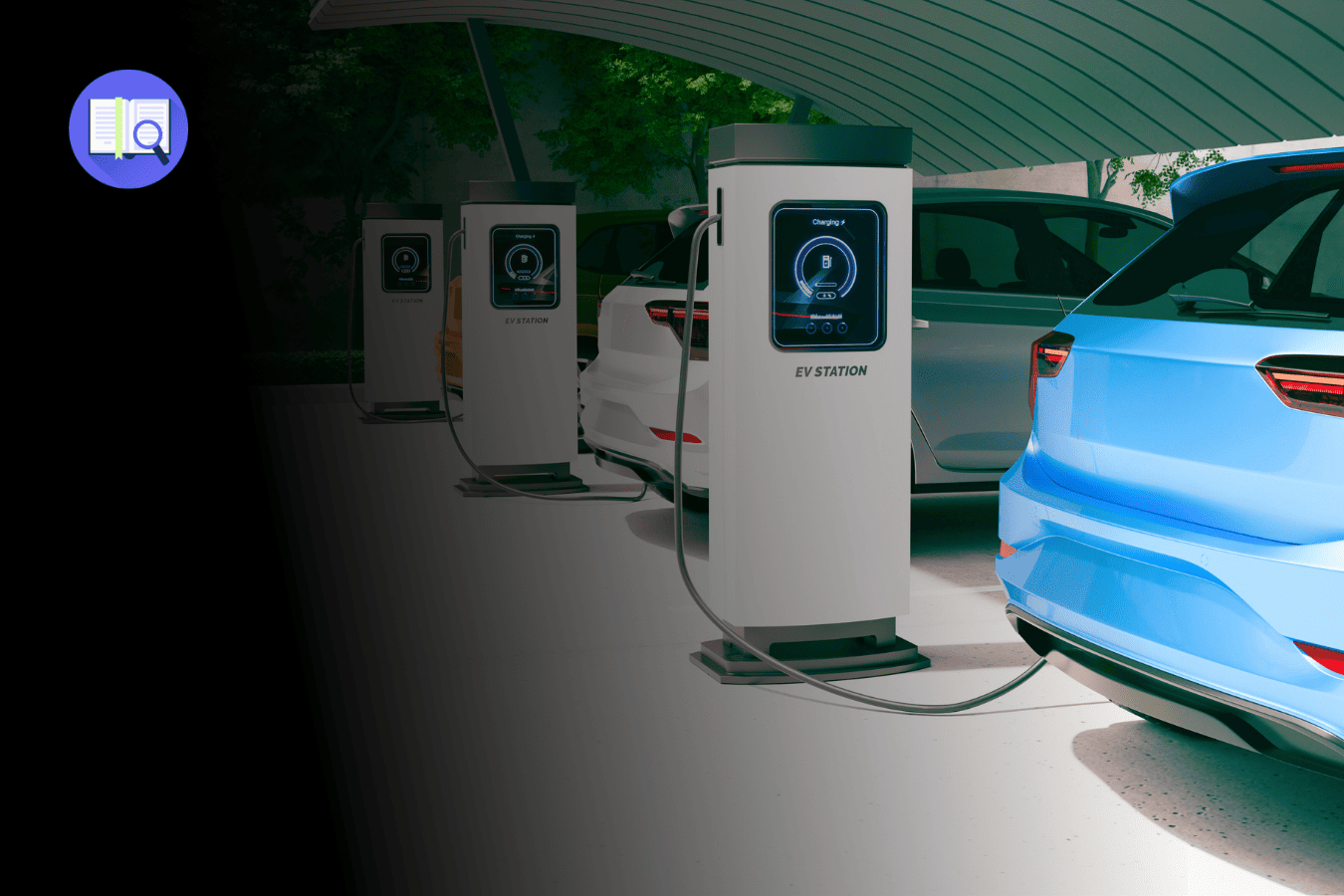
When EV charging stations work, nobody notices the spare parts behind the scenes.
Drivers plug in.
Sessions start.
Everything feels seamless.
But that smooth experience depends on dozens of small components quietly doing their job – and being ready to swap when they don’t.
Spare parts management is the invisible work that keeps charging networks reliable, even though it rarely gets the spotlight. That’s why it’s more than just an inventory task; it’s one of the biggest levers operators have to keep chargers online, drivers happy, and uptime targets intact.
Let’s talk about what actually matters.
Spare parts management for EV charging stations is the practice of deciding which components to keep on hand, where to store them, and when to reorder them, so chargers can be repaired quickly when something goes wrong.
In simple terms: It’s the difference between fixing a charger today versus putting up an “Out of Service” sign and waiting two weeks for shipping.
Maintenance reduces downtime. Spare parts make maintenance fast.
It’s tempting to treat spare parts like optional overhead – something to minimize. But here’s the reality: Downtime is far more expensive than parts sitting on a shelf.
Public charging reliability is under increasing scrutiny. For example, chargers funded under the US NEVI program are expected to meet 97% annual uptime per charging port. When a charger is down because a $200 component isn’t available, that target gets very hard to hit.
Spare parts inventory turns:
That’s not waste. That’s insurance.
To stock the right parts, you need to understand how chargers usually fail. Most failures fall into a few buckets:
Once you see these patterns, stocking decisions become much clearer.
Not all chargers are created equal. Neither are their spare parts needs.
Level 2 chargers are simpler, but they still have predictable weak points.
Common Level 2 spares include:
These parts fail frequently, are relatively easy to replace, and can take a charger completely out of service if missing.
DC fast chargers are more complex – and more sensitive.
Common DCFC spares include:
Many DC fast charger internals can only be serviced by qualified technicians. Stocking strategy here often focuses on fast-swap components and parts your service agreements allow you to replace.
This is where operators usually want a straight answer. So here it is – tiered and practical.
These are high-failure, high-handling, or quick-swap items that cause total downtime when missing.
If you only budget for one tier – make it this one.
These don’t wear as visibly, but when they fail, chargers disappear from your dashboard.
Many “offline” charger incidents are actually network or protection failures, not charger failures.
These are expensive and model-specific. Stock them carefully.
These are usually stored centrally or regionally, not at every site.
If you’re unsure about a part, ask four questions:
If the answer is “yes” to most of these, it probably belongs in your spare inventory.
You don’t need a PhD in supply chain management.
A simple rule: Stock enough to cover average usage during supplier lead time, plus a small safety buffer.
For high-traffic or compliance-driven sites, that buffer should be bigger. For low-use sites, smaller is fine.
Some operators also bundle parts into repair kits, which simplifies dispatch and avoids “we brought the wrong part” moments.
There’s no one-size-fits-all answer, but here’s a practical breakdown.
Best for:
This minimizes repair time.
Best for:
Best for:
Most mature operators use a mix of all three.
This is where things quietly fall apart.
Operators often stock:
To avoid this:
Compatibility tracking matters just as much as quantity.
Field-ready kits save time and frustration.
Always align kits with OEM and service agreement rules.
Most chargers communicate using OCPP (Open Charge Point Protocol) – a standard language chargers use to talk to backend systems.
When chargers go offline, the root cause is often:
Stocking the right spares means many “offline” incidents can be resolved quickly – sometimes without escalating beyond a routine work order.
You don’t need dozens. Focus on these:
These metrics tell you whether your inventory strategy is helping – or quietly hurting – reliability.
A simple, consistent flow works best:
Common mistakes to avoid:
That last one kills learning.
Spreadsheets work … until they don’t. Once you’re managing multiple sites, technicians, and vendors, things get messy fast.
Maintenance and field service platforms help operators:
Tools like FieldEx are used by EV charging operators to manage charger assets, preventive maintenance, work orders, and spare parts inventory in one place – so repairs happen faster and uptime stays predictable.
The tool matters less than the outcome: visibility and control.
Want to see FieldEx in action? Book a free demo, or simply get in touch. Let's chat!
Spare parts management isn’t about hoarding; it’s about knowing which small parts keep big systems running.
When the right parts are available, chargers stay online, technicians stay efficient, and uptime targets stop feeling like wishful thinking.
Start with connectors, cables, networking equipment, seals, and other high-wear or site-critical parts.
Cables, connectors, holsters, and networking components tend to fail first.
What parts fail most often on DC fast chargers?
Connector assemblies, protection components, cooling system parts, and networking gear.
Most operators use a mix: on-site for fast movers, regional stock for shared support, and central storage for expensive parts.
Because the fastest repair is the one where the part is already available.

.avif)


This website and its content are the property of FieldEx and are protected by copyright laws. © 2026 FieldEx. Any redistribution or reproduction of part or all of the contents in any form is prohibited, except with our express written permission.
FieldEx Pte Ltd Singapore