

.png)
In 2023, you could buy any charger, slap it on a wall, and call it a day. In 2026, if that hardware isn't NEVI-compliant, NACS-ready and Buy America certified, you’re essentially building a stranded asset.
The game has changed. The "Adapter War" is won – NACS (Tesla’s standard) is the new king. The federal money is flowing, but it comes with strings attached: a mandatory 97% uptime requirement that is aggressively audited. On top of that, we’re dealing with a grid that spans from the sub-zero winters of North Dakota to the melting tarmac of Phoenix.
Buying a charger in this environment isn't about finding the lowest price on a spec sheet. It’s about supply chain security. You need a partner who can navigate the "Buy America" paperwork, source a transformer when lead times are 40+ weeks, and deliver to 50 states without a hiccup.
Below, we break down the Top 13 Distributors commanding the US market in 2026. We have split them into four strategic categories so you can find the right partner for your scale. Ready? Let’s get crackin’.
Why they made the list: Wesco isn't just an electrical distributor; they are a supply chain behemoth with a $20B+ footprint. They excel at the "heavy" side of infrastructure. While others just sell you the charger, Wesco sells the switchgear, the transformer, and the cabling required to power it. They are arguably the most capable partner for complex, high-voltage depot electrification.
Why they made the list: Graybar has positioned itself as the expert on federal funding. Their "NEVI Toolkit" is a lifesaver for contractors, helping them navigate the complex "Buy America" regulations to ensure every bolt and screw complies with federal grant requirements.
Why they made the list: Operating under powerful local brands (like Viking Electric in the Midwest and Cooper Electric in the East), Sonepar combines local knowledge with a massive digital backend. Their "Digital Job Center" allows facility managers to track every asset in real-time across the country.

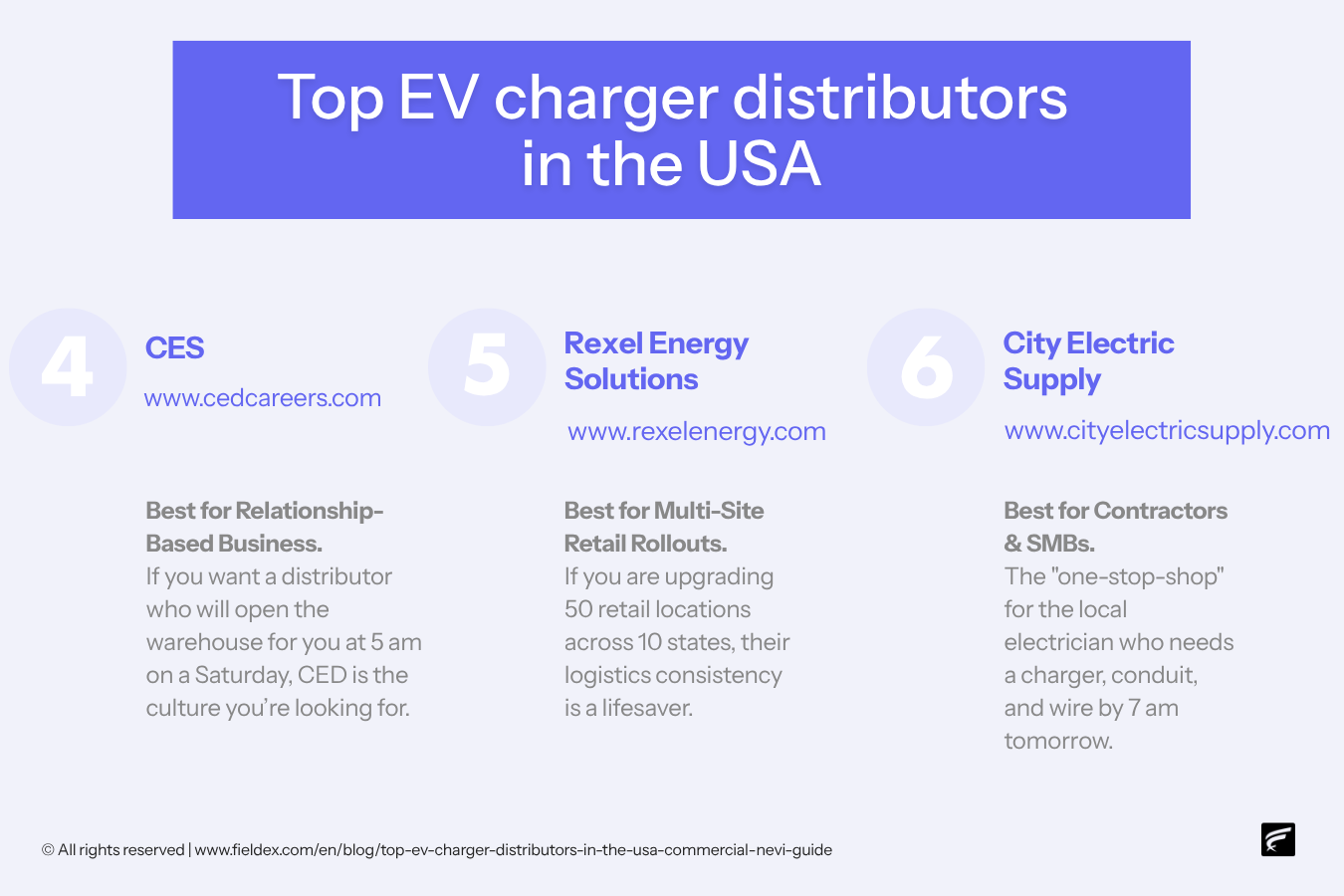
Why they made the list: CED operates with a decentralized model, giving their local managers huge autonomy. This means a CED manager in Texas can stock specific high-power units for oil & gas fleets, while a manager in California stocks sleek commercial units. They are incredibly agile for their size.
Why they made the list: Rexel specializes in "project kitting”. They will palletize the charger, the pedestal, the signage, and the pre-cut wire so it arrives at your job site as a single "install-ready" package. This reduces waste and speeds up installation by 30%.
Why they made the list: With a massive branch network and a dedicated CES EV Solutions division, they offer a personal touch. Their "Renewable Energy Specialists" will actually come to your site to walk the job with you.
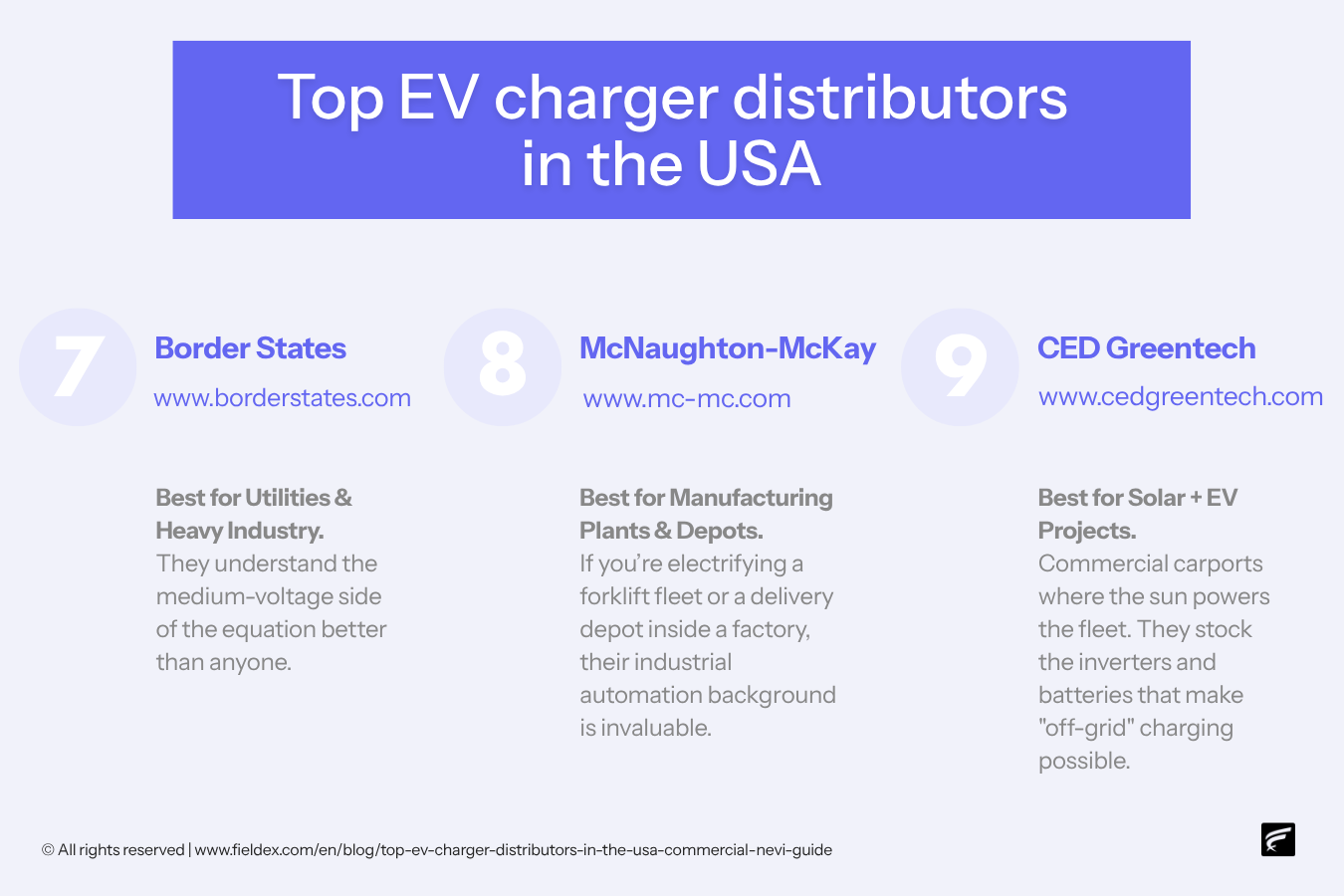
Why they made the list: Border States is 100% employee-owned and deeply embedded in the utility sector. They don't just sell chargers; they sell "grid resilience”. If you are a co-op or a municipal utility planning a public charging network, Border States has the engineering depth to help you design the grid connection itself.
Why they made the list: A massive player in the Midwest and the auto industry, McNaughton-McKay approaches EV charging with an "automation" mindset. They view the charger as a machine that needs to be integrated into your facility's logic.
Why they made the list: While part of CED, Greentech operates as a distinct entity focused purely on renewables. They are the bridge between the roof and the road. While others sell chargers as an add-on, CED Greentech sells them as part of a solar ecosystem.
Why they made the list: A global powerhouse in PV distribution, Krannich has a rapidly growing EV division in the US. They specialize in "sector coupling" – connecting the PV system, battery storage, and EV charger into one intelligent loop.
Why they made the list: Grainger is the king of MRO (maintenance, repair and operations). If you are a facility manager who already buys safety gloves and HVAC filters from Grainger, you can now add a commercial EV charger to that same PO.

Why they made the list: Although a Rexel company, Platt operates with huge autonomy in the West. They are deeply embedded in the tech-heavy markets of California, Oregon and Washington, where EV adoption is highest.
Why they made the list: Dominant in the South, Elliott offers a "turnkey" approach. They have a team of certified professionals who can help design the system, making them a favorite for projects in Texas and the Sunbelt.

Let’s be real: You can't DIY a 480V DC Fast Charger. You need a partner who understands the NEC (National Electrical Code), local permitting from 19,000+ municipalities, and the specific "Make-Ready" incentives of your local utility.
We have broken this down by Category so you can call the right crew for the job.
Best for: National Residential & Light Commercial Rollouts (eg Fleet-at-Home).
If you are buying an EV from a major OEM (Ford, GM, BMW), Qmerit is likely the partner powering their "home install" offer. They don't employ every electrician directly; instead, they manage a massive network of vetted, certified local contractors.
Best for: Airports, Parking Structures, Fortune 500 Campuses.
ABM manages the janitorial and engineering for half the office buildings in America. They have pivoted hard into EV infrastructure. Because they are often already in the building changing the lightbulbs, they know where the spare electrical capacity is hiding.
Ameresco is an "Energy Service Company" (ESCO). They don't just install chargers; they upgrade your entire facility's energy efficiency to pay for the chargers. They specialize in federal and municipal projects where the budget is complex.
Best for: Depots, Logistics Hubs, and High-Voltage DCFC.
When you need to power a fleet of electric semi-trucks, you aren't calling a residential electrician. You are calling Faith. They specialize in mission-critical, high-voltage infrastructure. They build the "microgrids" that keep Amazon and FedEx depots running.
Historically a builder of power plants and dams, Black & Veatch now builds the super-hubs of the EV world. They handled the rollout of the Electrify America network. They are engineering-first and expensive, but they get the permit approved when no one else can.
Best for: Deep local expertise (California & The Northeast).
California is 50% of the US EV market, and Baker Electric is the dominant force there. Based in San Diego, they have installed more infrastructure in the Golden State than almost anyone. They understand Title 24 compliance better than national firms.
Operating out of New York, they are experts in the cold-weather realities of the Northeast grid. They handle massive utility-scale projects and have deep relationships with National Grid and Con Ed.
Selecting a distributor is a critical procurement decision, but it is only "Day 1”.
In the US, the NEVI (National Electric Vehicle Infrastructure) program demands 97% uptime. This isn't a suggestion; it's a requirement. If your chargers fall below this metric, you risk losing your funding or facing clawbacks.
But the US geography makes this hard. A technician in Phoenix dealing with 110°F heat faces completely different failure modes than one in Chicago dealing with -10°F deep freezes.
This is where FieldEx enters the equation.
FieldEx is the operating system for the energy transition. It does not replace your CPMS (like ChargePoint or EV Connect); FieldEx powers the workforce that keeps the hardware compliant.
For US asset managers, FieldEx ensures:
The "free money" era is ending; the "compliance era" is here.
As you plan your infrastructure for 2026, look beyond the initial price tag. Look for a distributor who can guarantee Buy America compliance, secure your supply chain against global disruptions, and support you with technical engineering.
The 13 names above are the best in the business. Choose the one that fits your scale, and then let FieldEx help you keep the lights on.
Ready to close the maintenance gap? Book a free FieldEx demo today, or simply get in touch. We're here to help.
The National Electric Vehicle Infrastructure (NEVI) program provides federal funding for chargers but requires them to have 97% uptime, use CCS/NACS connectors, and be made in the USA.
Yes. NACS (North American Charging Standard) is now the de facto standard used by Tesla, Ford, GM, and Rivian. Installing a charger with only CCS is installing obsolete tech.
To qualify for federal grants, 55% of the cost of the charger components must be manufactured in the United States. All distributors listed above can identify which SKUs meet this standard.
Yes, if they use OCPP (Open Charge Point Protocol). However, for warranty sanity, we recommend sticking to one or two hardware partners.
Chargers are generally available, but switchgear and transformers can still have lead times of 40+ weeks. Order your infrastructure before you order your EVs.
For "DC Fast Charging" (Level 3), yes. Most industrial sites have this, but retail locations may need a utility upgrade, which can be expensive and slow.
This is a program where the utility company pays for the infrastructure up to the charger (the transformer, conduit, and wire), leaving you to pay only for the charger itself. Ask your distributor about local "Make-Ready" incentives.
Qmerit is a digital platform that manages installation. They don't employ the electricians directly but vet them and manage the project, making them popular for national fleet rollouts.

.avif)


This website and its content are the property of FieldEx and are protected by copyright laws. © 2026 FieldEx. Any redistribution or reproduction of part or all of the contents in any form is prohibited, except with our express written permission.
FieldEx Pte Ltd Singapore