

.png)
If you’re managing infrastructure in the UK, you know the reality: the biggest threat to your hardware isn't usage – it’s the environment.
British asset managers are fighting a constant war against the damp. You deal with relentless moisture ingress that corrodes PCB boards, "grey sky" days that limit solar yield, and a grid so constrained that getting a new DNO connection can take 18 months.
Buying a charger in this environment isn't just about finding the cheapest box. It’s about finding hardware that understands "PEN Fault Protection" (so you don't have to dig up your car park for an earth rod) and a distributor who actually has stock in a post-Brexit supply chain.
Below, we break down the top 10 distributors commanding the UK market in 2026. We’ve split them into three categories so you can find the right partner for your scale.
Why they made the list: With over 240 locations, Edmundson isn't just a distributor; they are the backbone of the UK trade. Their dedicated UK Greentech division is a national specialist in solar PV and storage, backing their massive stock levels with in-house design capacity to ensure you get a "one-stop" solution delivered by their own fleet.
Edmundson holds the Royal Warrant. If they are reliable enough to supply the King’s estates, they are likely robust enough for your business park.
Why they made the list: YESSS has exploded onto the scene, becoming the fastest-growing wholesaler in the UK with over 95 branches. Their "YESSS Renewables" division is aggressively winning market share from the old guard by stocking everything from domestic 7kW units to 200kW DC fast chargers.
Why they made the list: With nearly 400 branches, you are never more than 20 minutes from a CEF. For facility managers, they are the emergency service of the industry. When a charger is vandalized or a breaker trips on a Friday afternoon, CEF is where you go for the replacement parts.
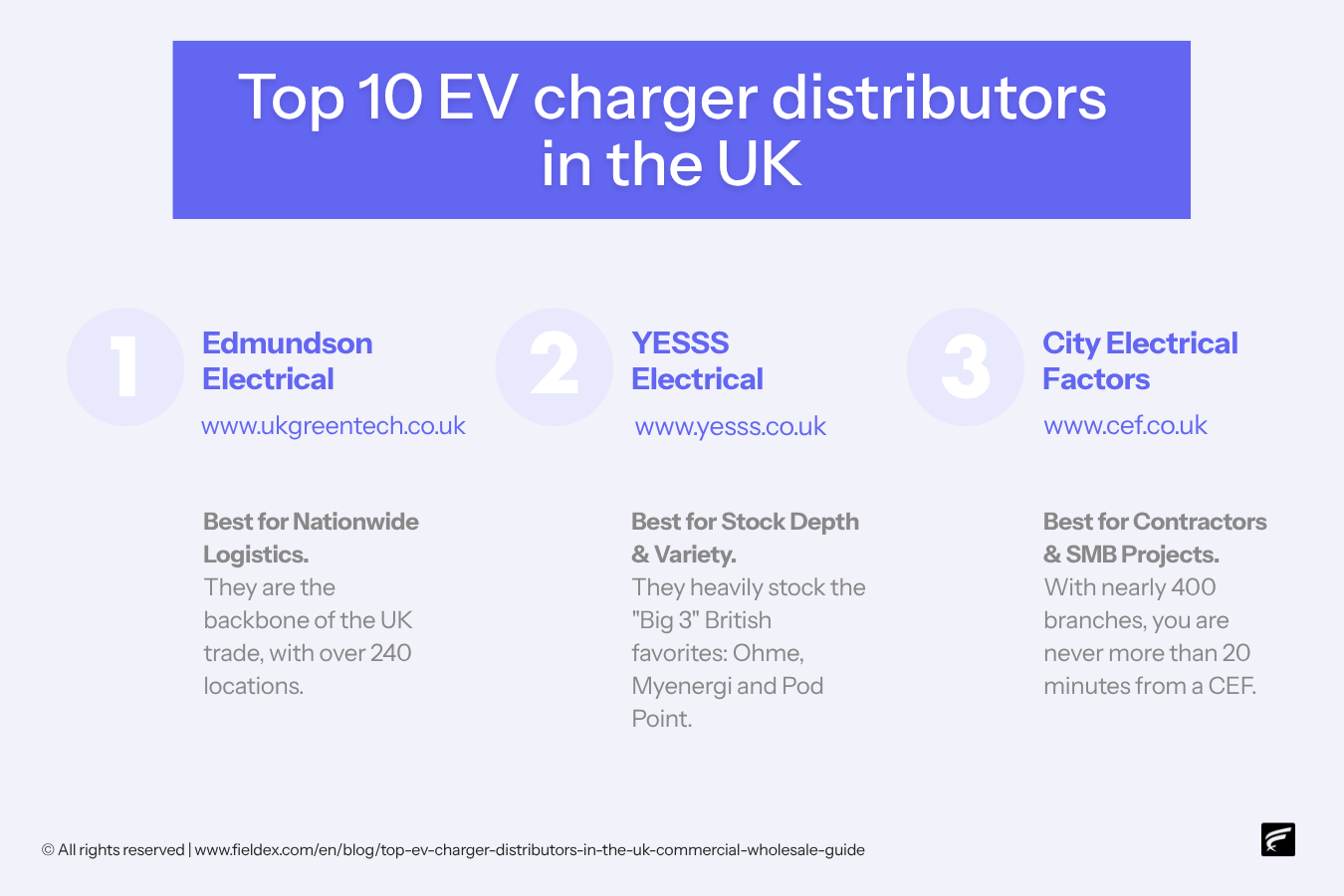
Why they made the list: Rexel focuses on the "Smart" side of energy. Their project management teams are excellent at navigating complex commercial retrofits in tight urban grids (like London), where power availability is often a nightmare.
Why they made the list: Replenishh is unique because they are "powered by Rapid", an electronics giant with 40 years of logistical experience. This means they combine the deep buying power of a major industrial distributor with a laser focus on EV infrastructure. They don't sell lightbulbs or toaster ovens; their entire mission is to make the EV procurement process straightforward for contractors and procurement professionals.
Why they made the list: Founded in 2004, Segen has grown alongside the industry to become the UK’s largest supplier of renewable energy components. As a master distributor for Tesla Powerwall and the only UK distributor integrating OpenSolar software, they are the heavyweight champion of the "Solar + EV" ecosystem.
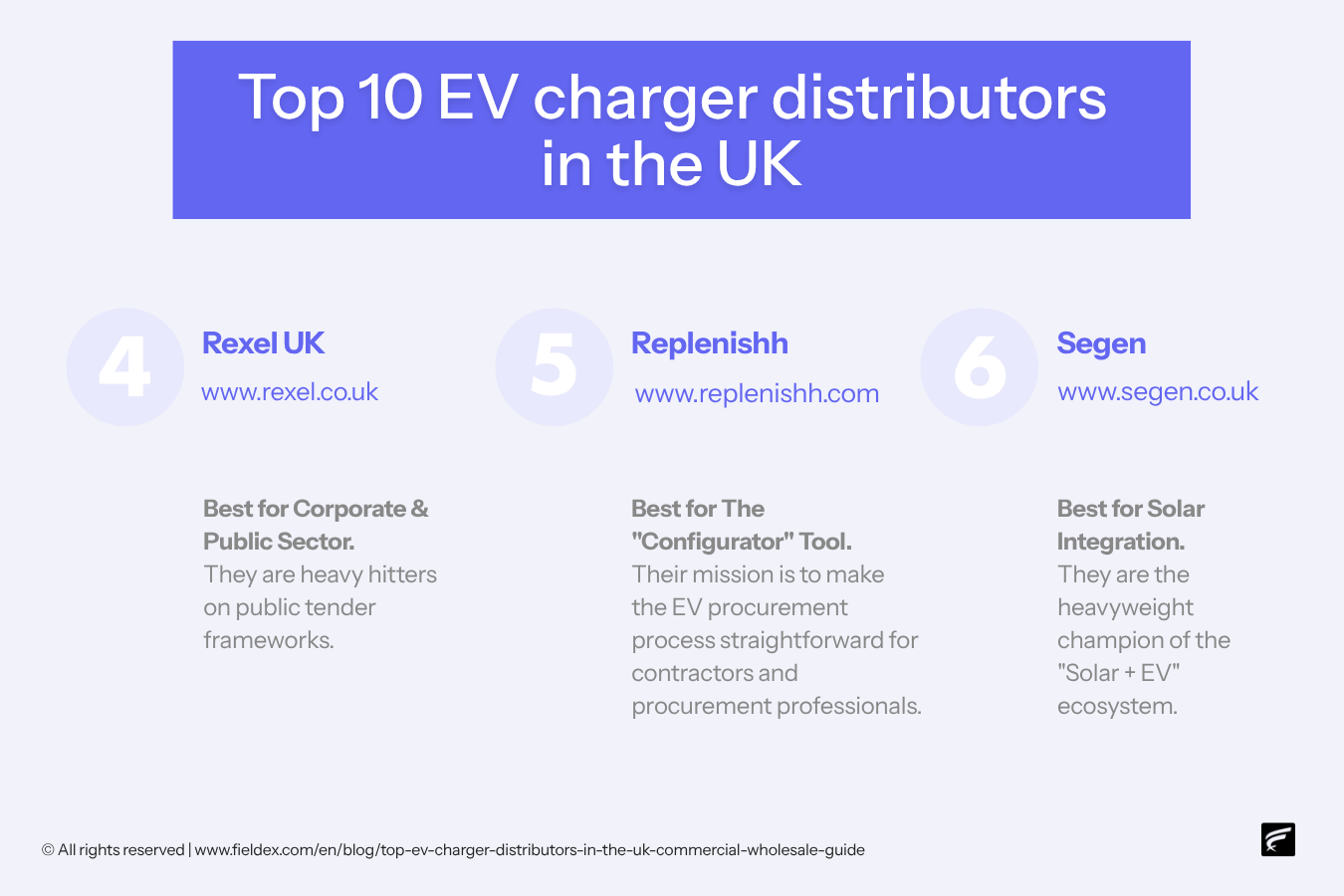
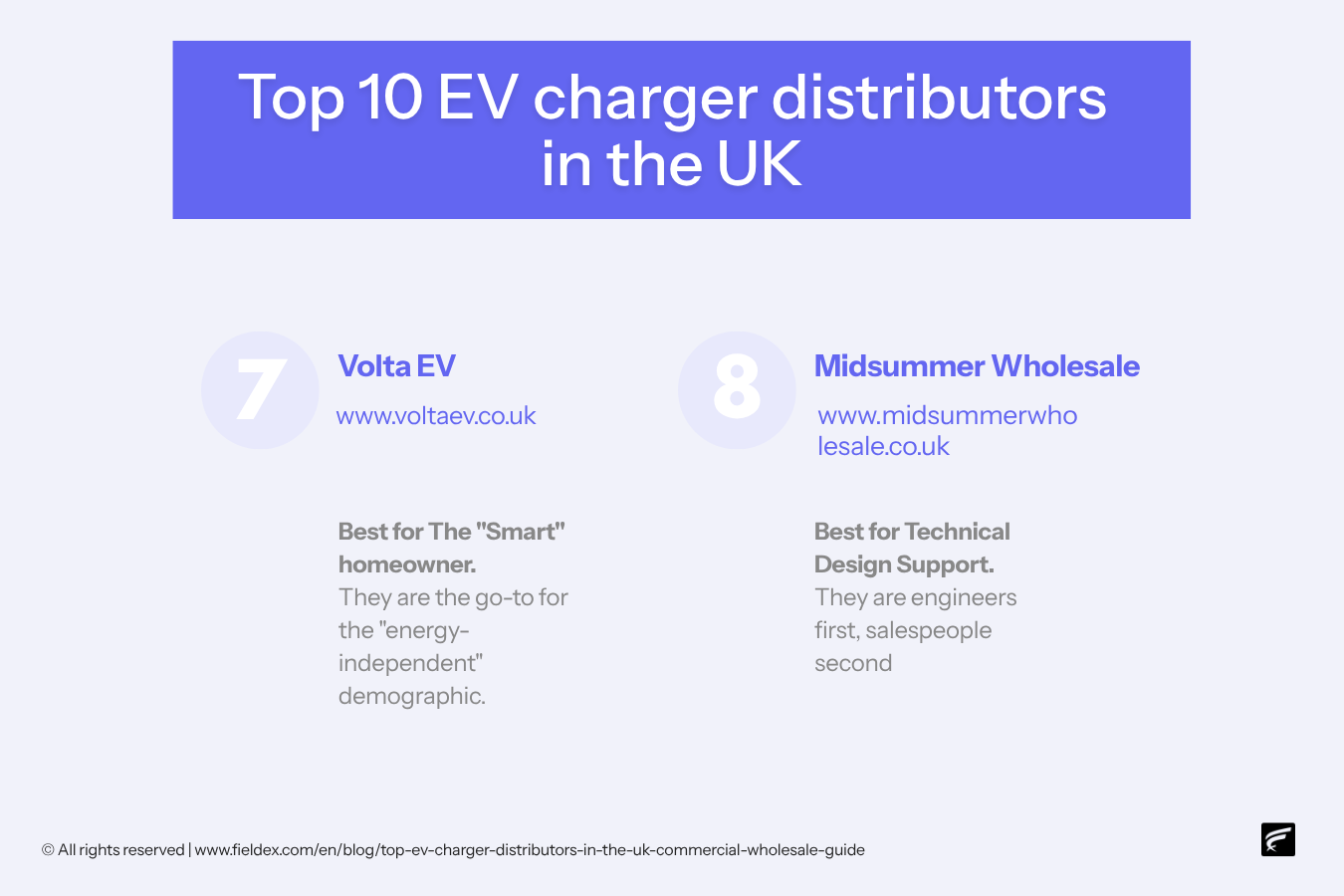
Why they made the list: Volta EV has carved out a massive niche as the "Amazon" of the eco-conscious installer. Their team specializes in the "Solar + EV" ecosystem, helping customers design setups that maximize energy generation rather than just drawing from the grid.
Why they made the list: While smaller than Segen, Midsummer is beloved by installers for their software. They developed "Easy PV," a design tool that allows installers to map out a full solar+EV system in minutes.
Why they made the list: Rolec boasts three decades of experience and a workforce of 140+ at their purpose-built factory in Lincolnshire, they don't just assemble; they design and manufacture from the ground up.
The company operates three distinct divisions – Rolec EV, Rolec Marina and Rolec Leisure – giving them a unique cross-sector expertise that few competitors can match.
Why they made the list: Sevadis claims a 10-second technical response time and a 20-minute average install time for their flagship units. They have partnered closely with Monta, giving them one of the best software integrations right out of the box.
.png)
Selecting a distributor is a critical procurement decision, but it is only "Day 1". Whether you choose a rugged Rolec pedestal or a smart Ohme wallbox, every asset faces the same adversary: the British climate.
In the UK, moisture ingress is the silent killer. It corrodes internal components long before the warranty expires.
On top of that, there’s currently a massive "maintenance gap”. Chargers are being rolled out faster than there are trained technicians to maintain them. To make matters worse, the Public Charge Point Regulations 2023 now mandate 99% reliability for rapid chargers. Failing to meet this can result in hefty fines.
This is where FieldEx enters the equation.
FieldEx is the operating system for the energy transition. It does not replace your CPO (like Monta or Fuuse); it powers the workforce that keeps the hardware compliant.
For UK asset managers, FieldEx ensures:
Don’t just install infrastructure. Ensure it actually works.
Keen to see how FieldEx closes the maintenance gap? Book a free demo today, or get in touch to know more. We’d love to hear from you.
The UK is racing toward an electric future, and the distributors listed above are providing the essential hardware to get us there. Whether you need the nationwide reach of Edmundson or the rapid service of Sevadis, the market is mature and ready.
But remember: the real challenge starts after the van drives away. As you plan your rollout for 2026, think beyond the install. Think about the technician who needs to fix it on a rainy Tuesday in November. Give them the right tools, and your grid will stay green.
In the UK, most buildings use a "PME" earthing system. If the neutral wire breaks (a PEN fault), the car can become live. "PEN Fault Protection" (built into chargers like Sevadis and Easee) disconnects the car automatically, saving you from installing a costly earth rod.
Introduced in 2021, these rules mandate that all new home and workplace chargers must have "smart" functionality – specifically, the ability to schedule charging during off-peak hours to protect the National Grid.
V2G allows EVs to push energy back to the grid. The UK is a global leader in this, with major trials by Octopus Energy and Ovo Energy proving that fleets can earn money by stabilizing the grid.
Budget between £1,500 and £5,000 per socket, depending on groundworks. If you need a new grid connection (DNO upgrade), costs can skyrocket.

.avif)


This website and its content are the property of FieldEx and are protected by copyright laws. © 2026 FieldEx. Any redistribution or reproduction of part or all of the contents in any form is prohibited, except with our express written permission.
FieldEx Pte Ltd