
.png)
.png)
Managing assets in Melbourne is a unique beast. You’re operating in the country’s logistics heartland, but you’re doing it under some of the most erratic weather conditions on the planet. That famous 'four seasons in one day' isn't just small talk; it's a stress test for your infrastructure.
On top of that, the Victorian grid is changing faster than anywhere else. With the aggressive ZEV Commercial Sector Innovation Fund and the massive rollout of depot charging in the western suburbs, the demand for power is skyrocketing.
Buying a charger here means finding a partner who understands these local quirks. You need a distributor with a warehouse in Tullamarine or Moorabbin, not a call center in another time zone.
Below, we break down the Top 7 Distributors commanding the Victorian market in 2026. These are the teams with stock on the ground. (Stick around to find out who helps you keep it running).
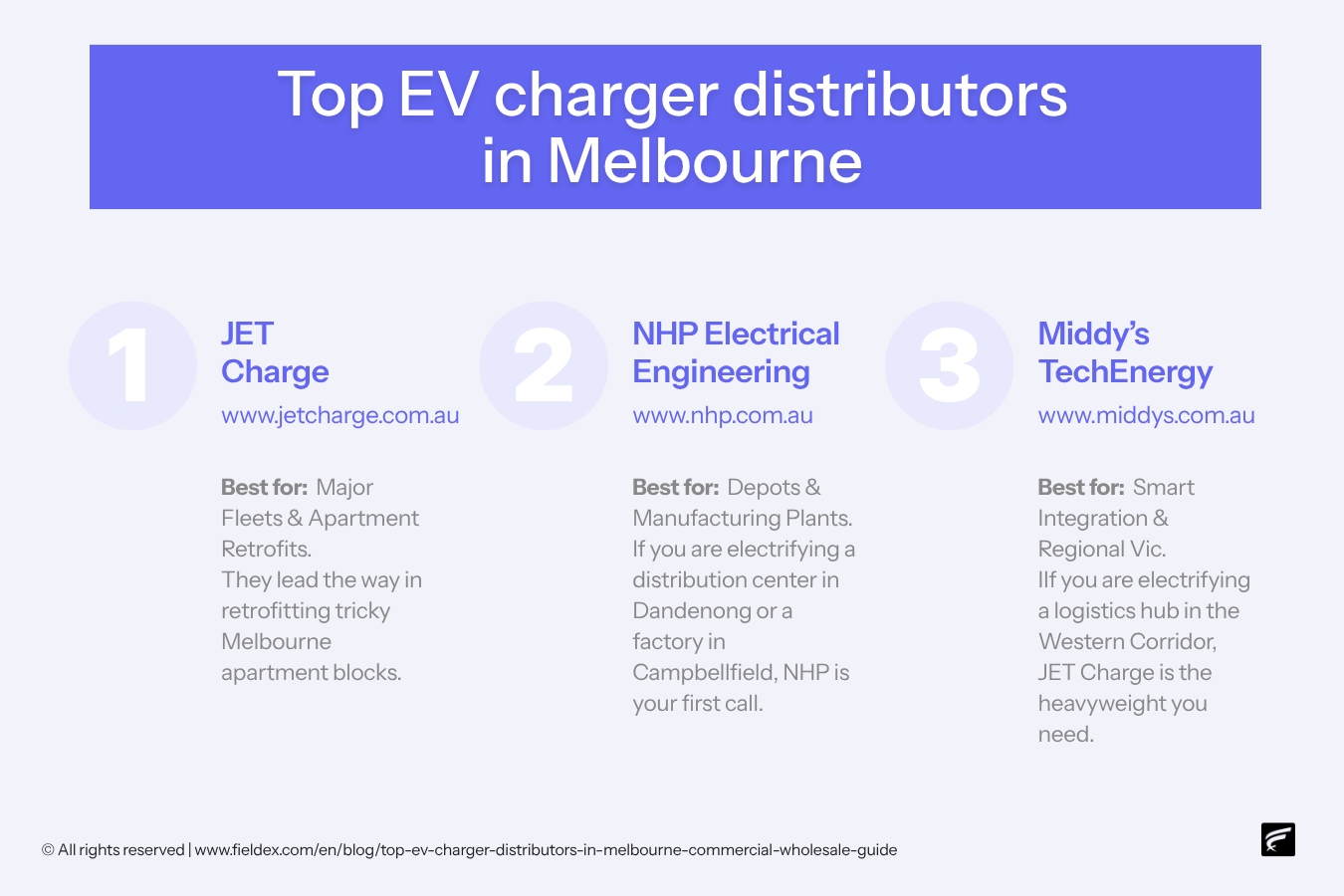
Why they made the list: JET Charge is a national giant, but make no mistake: they are a Melbourne company through and through. Headquartered in Port Melbourne, they are the "Operating System" for the city's biggest EV projects. If you drive a Tesla or a Volvo in Victoria, JET Charge likely coordinated the install. They are the home team advantage you want on your side.
Their Port Melbourne HQ isn't just an office; it's an R&D lab. They are actively testing vehicle-to-grid (V2G) technology right here, working on ways to let your car stabilize the grid during those notorious Victorian summer peak events.
Why they made the list: If JET Charge is the tech wizard, NHP is the industrial muscle. With a massive facility in Laverton North, NHP is the go-to for "heavy metal" infrastructure. They don't mess around with flimsy consumer gadgets; they supply the mining-grade Delta hardware that powers electric buses and trucks.
NHP’s Laverton North facility allows for local customization. While others are waiting for shipments from overseas, NHP can often modify and dispatch units locally, which can save weeks on a construction schedule.
Why they made the list: You can't drive through a Melbourne suburb without seeing that bright pink building. Headquartered in Mount Waverley, Middy's is Australia’s largest family-owned electrical wholesaler. But they aren't stuck in the past; their TechEnergy division is surprisingly sophisticated, driving smart home and commercial integration.
Middy's runs a dedicated "Integration" service. They don't just sell the box; they can help design the entire electrical ecosystem, linking your EV charger to your solar and home automation system.
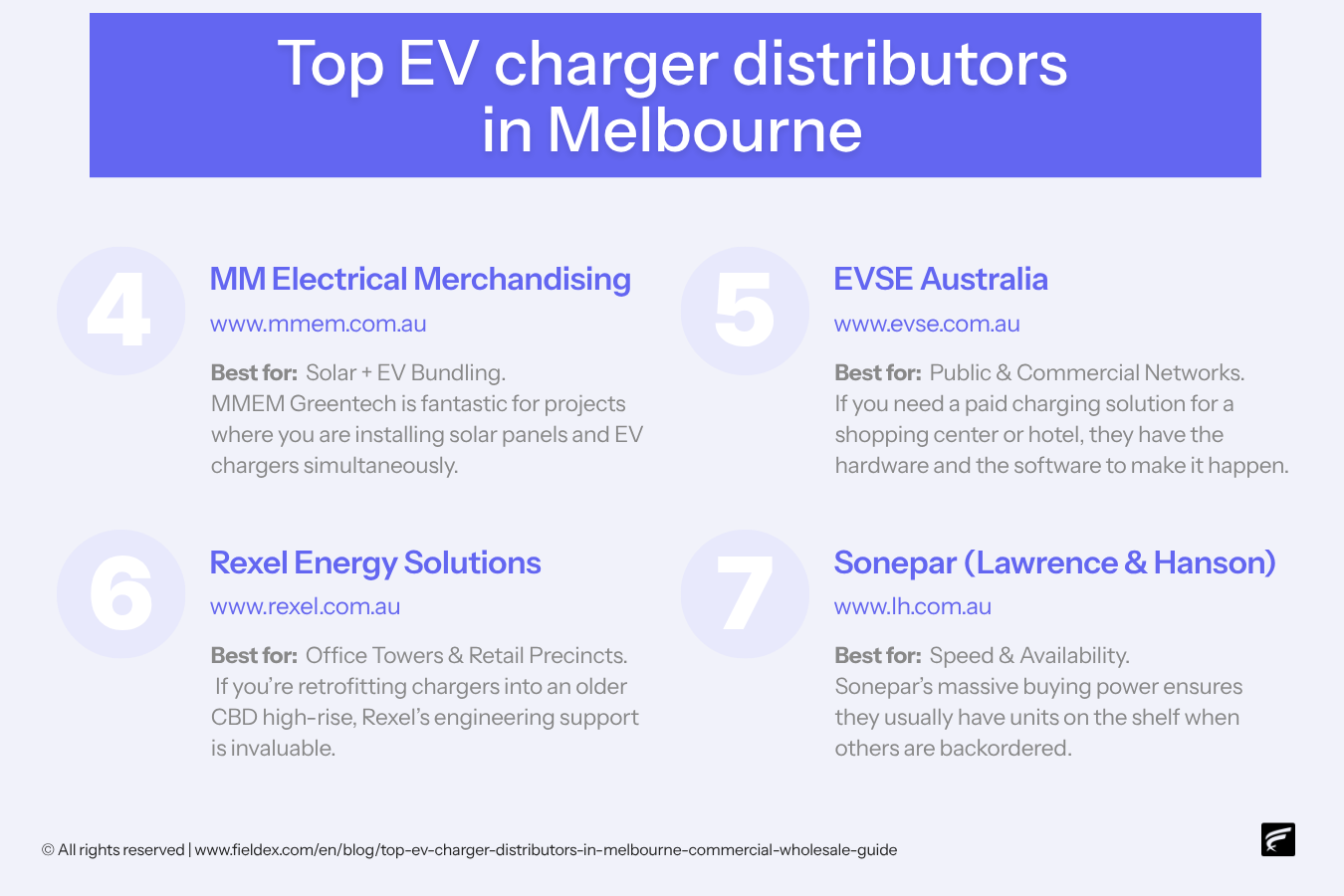
Why they made the list: You might know them as Haymans, T.L.E, or AWM, but the parent company MMEM is a behemoth in the Victorian market. Their specialized Greentech division (with key hubs in Airport West and Moorabbin) is dedicated entirely to renewable energy. They are the wholesaler of choice for installers who need deep technical support on solar-plus-storage projects.
With over 330 branches nationwide and a massive presence in Victoria, their internal logistics network is unrivaled. If a part isn't in Melbourne, they can usually shuttle it from a regional branch overnight.
Why they made the list: While they have a strong Sydney presence, EVSE Australia maintains a key office in Port Melbourne to service the southern states. They have carved out a niche as the "Strata Specialists," helping body corporates navigate the complex world of shared charging in high-density areas like South Yarra and Docklands.
Their Port Melbourne team is deeply plugged into the local contractor network, meaning they can often recommend a certified installer if you don't already have one.
Why they made the list: With a key location in Little Lonsdale St, Rexel is the partner of choice for CBD commercial upgrades. Their Rexel Energy Solutions (RES) division focuses on the "smart" side of energy, helping facility managers in the city loop navigate complex load management issues.
Rexel offers specialized training for installers, ensuring that the complex commissioning process (getting the charger to talk to the internet) is done right the first time.
Why they made the list: Since 1886, Lawrence & Hanson (now Sonepar) has been supplying Aussie sparkies. With branches in almost every Melbourne suburb, they are the logistical backbone of the trade. If a charger gets smashed by a delivery truck in Richmond, L&H is where the replacement comes from.
Sonepar is investing heavily in digital tools, allowing contractors to check real-time stock levels at their local branch before they even leave the job site.
Let’s cut to the chase. You can order a pallet of DC fast chargers today, but without a licensed A-Grade electrician, they are just expensive paperweights. The distributors above handle the logistics, but they don't pull the cable. You need a partner who understands Victorian compliance, switchboard protection, and how to get a Certificate of Electrical Safety (COES) signed off without delay. These are the crews getting their hands dirty across Melbourne.
Specializing in both home and commercial installs across Melbourne, Scenic Energy is known for handling the entire process – from the initial site assessment to the final commissioning. They are experts at navigating the "Solar + EV" integration that many Victorian homes demand.
Based in the Southeast suburbs, Live Volts are certified installers for major brands like Tesla. They have a reputation for neat, compliant work in both domestic and workplace settings, ensuring your charger doesn't trip your house safety switch.
If you are in Yarraville, Footscray, or Williamstown, LC Electrical is your local expert. They understand the quirks of older inner-west weatherboard homes and can manage the necessary switchboard upgrades to get you charging safely.
Chargers don't strictly break between 9 and 5. Marlec offers 24/7 emergency services across Melbourne, making them a solid choice for commercial operators who can't afford downtime.
Before you sign that purchase order, let's distinguish between the two key players in your infrastructure rollout. This is where most first-time buyers get confused.
If you confuse the Distributor with the Operator, you end up with a great box and a great billing app, but no plan for when the screen breaks.
Selecting a distributor is a critical procurement decision, but it is only the starting line. Whether you choose a rugged unit from NHP or a smart tower from EVSE, every asset faces the same adversary: The Environment.
In Melbourne, "four seasons in one day" isn't a cliché; it's a stress test for your equipment. Rapid thermal cycling (expanding and contracting plastic) degrades seals, leading to water ingress.
We are currently seeing a "Maintenance Gap" in Victoria. We are rolling out hardware faster than we are training technicians to maintain it. A standard CPMS might ping you with "Error 404: Connector Fault," but it can't tell you if the technician has the right spare part in their van or if they’ve completed the mandatory safety checks.
This is where FieldEx enters the equation.
FieldEx is the operating system for the energy transition, powering the workforce that keeps the hardware alive.
For Victorian asset managers, FieldEx ensures:
Don’t just install infrastructure. Ensure it actually survives the weather.
Anyone with a credit card can buy an EV charger in Melbourne today. The market is flooded with options, from the budget-friendly units at the wholesaler to the rugged industrial gear at NHP.
But the difference between a successful rollout and a failed pilot project isn't the brand of hardware you buy – it's how you look after it on "Day 2” and beyond.
In a state where grid stability is a constant conversation, FieldEx ensures your assets are an asset, not a drain. We verify the repairs, track the serial numbers, and enforce the safety checks that keep your site legal and your chargers online.
Want to see FieldEx in action? Book a free demo today, or just reach out to learn more. We’re here to help.
Yes. While some older programs have closed, the ZEV Commercial Sector Innovation Fund and specific fleet charging contracts are active. Check the "Buying for Victoria" website for the latest state purchase contracts.
JET Charge and EVSE Australia are the leaders here. They both have extensive experience navigating the complex owners corporation approvals required for retrofitting Melbourne strata buildings.
Yes. You will need a Certificate of Electrical Safety (COES) issued by a licensed electrician. For commercial builds, you may also need council planning approval if the charger is on public land or affects heritage overlays.
A distributor (like Middy's) sells the hardware. An installer (like Scenic Energy) puts it in. FieldEx connects the two by managing the maintenance after the install is done.
Rapid temperature swings (expansion and contraction) can damage seals and electronics in cheap chargers. Using "Australian-spec" hardware from reputable distributors like NHP ensures your unit can handle the thermal shock.
Technically yes ("Level 1" charging), but it is painfully slow (2km of range per hour). For business or regular use, you need a dedicated Level 2 wallbox installed by a pro.
EVSE Australia has an office in Port Melbourne, and Middy's branches often have display units. Seeing the build quality in person is highly recommended before a bulk purchase.
A simple home install might cost $800-$1,500 AUD (plus the charger). Commercial installs vary wildly depending on whether you need a switchboard upgrade, often costing $5,000+ per point.
Some installers like Marlec Electrical offer 24/7 emergency services. However, having a maintenance contract managed through a platform like FieldEx ensures you have a guaranteed response time (SLA).
It’s the industry term for the shortage of qualified technicians relative to the number of chargers being installed. It leads to long downtimes unless you have smart software to manage your workforce efficiently.

.avif)


This website and its content are the property of FieldEx and are protected by copyright laws. © 2026 FieldEx. Any redistribution or reproduction of part or all of the contents in any form is prohibited, except with our express written permission.
FieldEx Pte Ltd