

.png)
In 2026, the green energy transition is no longer just a "deployment" challenge – it is a maintenance and compliance challenge. For operators of Electric Vehicle (EV) charging networks, the honeymoon phase of rapid installation has been replaced by the brutal reality of the NEVI (National Electric Vehicle Infrastructure) 97% Uptime Mandate.
Efficiency is what you aim for on a good day; Operational Resilience is what keeps your federal funding intact on a bad one. When a charger goes offline due to a cut cable or a utility surge, you aren't just losing a session – you’re facing a potential "clawback" of millions in federal subsidies. The difference between a crippling penalty and a protected rating lies in one critical variable: T_excluded (Excluded Time).
This guide provides the technical "helpline" your team needs to document external failures with surgical precision, ensuring that the "Physical Reality Gap" doesn't become a financial one.
Under 23 CFR 680.116 (National Electric Vehicle Infrastructure Standards), recipients of federal funding must ensure each charging port maintains an annual average uptime of at least 97%. Failure to meet this standard on a per-port basis can lead to performance deductions or the permanent "clawback" of federal funds.
The math is brutal: your uptime is calculated by removing proven "excluded" minutes from your total outage time.
The formula used by federal regulators is:
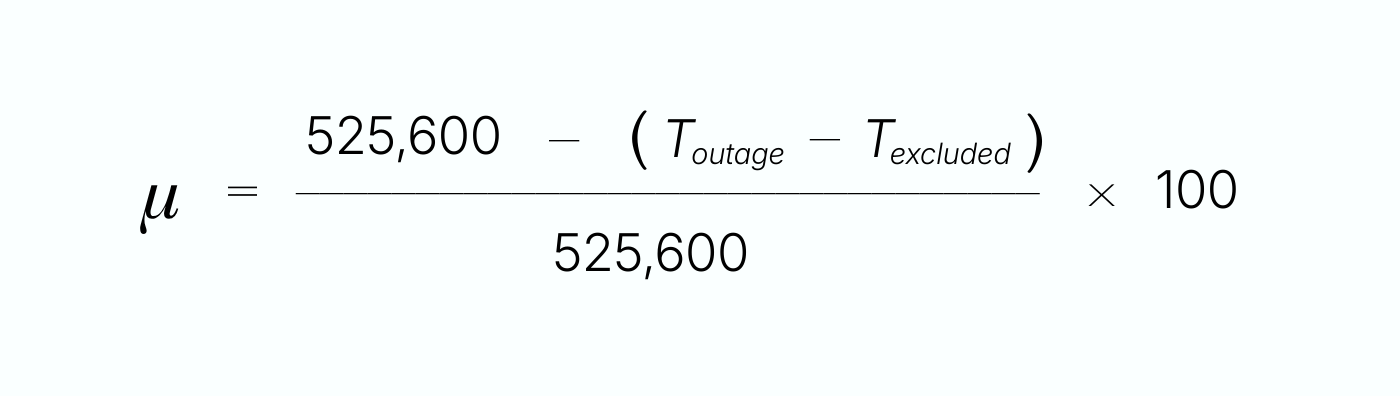
(Note: 525,600 is the total number of minutes in a 365-day year.)
T_excluded includes outage minutes caused by factors outside the operator's control, specifically electric utility service interruptions, vandalism, natural disasters, or failures caused by the vehicle itself. Scheduled maintenance is also excludable, provided the operator can demonstrate the port would otherwise be operational.
Most Charge Point Management Systems (CPMS) will tell you a charger is "Offline" but won't tell an auditor why. If a copper thief cuts your cables, the CPMS just sees a lost heartbeat. Without physical verification tied to a vandalism exclusion code, that time counts against you.
Keep this reference in your technician's glove box to ensure every "outside-of-control" event is credited.
Successful audit defense requires a Four-Point Proof protocol: a context shot showing the Station ID, a close-up of the physical damage, a photo of the Lockout/Tagout (LOTO) safety procedure, and a final Restoration photo proving the port is back in "Available" status.
In FieldEx, we use Checklist-Driven Automation to ensure the tech can't close the work order until these four points of evidence are uploaded.
Many critical infrastructure sites are in "dead zones" where connectivity is unreliable. To maintain compliance, technicians must be able to capture timestamped photos offline, ensuring the "End of Outage" is recorded the moment work is finished, not hours later when they regain signal.
Real talk: We’ve seen operators lose 48 hours of uptime because their system didn't know the local 5G tower was down for maintenance. If the tech had just taken a screenshot of their phone's "No Service" bars at the site, that downtime would have been wiped from the record as a third-party outage. FieldEx solves this by treating the mobile device as the System of Record.
Documentation is not a "boring" administrative task; it is the System of Record that secures your "license to operate" in the high-stakes green infrastructure economy. In a market currently suffering from "AI Fatigue", where theoretical optimization often fails the test of a physical truck roll, the winners will be the teams that prioritize Audit-Ready Resilience over hype.
By adopting a Four-Point Proof protocol and leveraging a physical execution layer that functions even when the signal drops, you do more than just survive a NEVI audit. You build a reputation for reliability that attracts investors and satisfies regulators.
Don't let your compliance strategy live in a spreadsheet. Build it into every work order.
Ready to bridge the gap between digital monitoring and physical reality? Book a free FieldEx demo today, or reach out. We’re here to help.

.avif)


This website and its content are the property of FieldEx and are protected by copyright laws. © 2026 FieldEx. Any redistribution or reproduction of part or all of the contents in any form is prohibited, except with our express written permission.
FieldEx Pte Ltd