

.png)
We’ve all seen the brochure; the glossy render shows a sleek row of EV chargers or a pristine battery container sitting next to a solar array, all bathed in golden-hour sunlight. The sticker price for the hardware looks manageable. You run the ROI model, and the numbers look good.
Then you break ground.
Suddenly, you aren't just buying a charger; you’re buying a trench. You’re buying a transformer upgrade. You’re buying a structural analysis for a concrete pad that turned out to be sitting on a swamp.
In the world of green infrastructure, the hardware is often just the tip of the iceberg. The "balance of system" (BoS) costs – the civil work, electrical upgrades, and permitting purgatory – can easily double your initial budget. As we transition to decentralized assets, understanding the total cost of deployment is critical.
If you’re managing an installation project, here’s the transparency guide you didn't get from the sales rep.
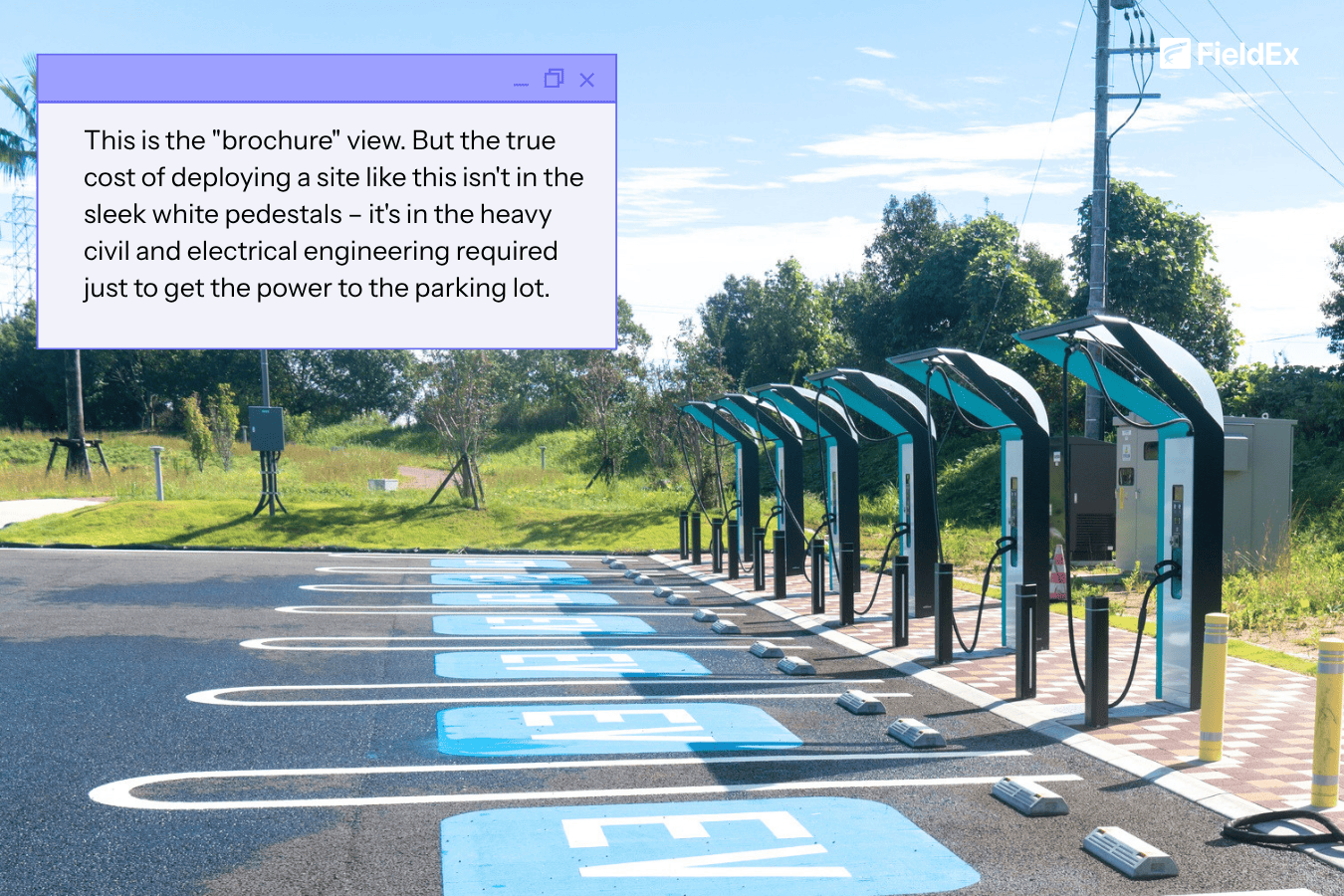
Everyone forgets about the dirt until they have to move it.
This is where the "green umbrella" strategy gets real. You aren't just plugging in a lamp; you are adding a load equivalent to a supermarket.
Hardware is easy. Bureaucracy is hard.
You can’t just flip the switch.
You can’t manage a complex, multi-vendor infrastructure project via text message and a shared spreadsheet. Well, you can, but that is usually how "hidden costs" turn into "surprise margin killers."
The uncomfortable truth is that the "maintenance gap" often begins before the asset is even turned on. A sloppy installation – missing warranty paperwork, unverified torque settings or zero photos of the underground conduit – creates a data black hole that haunts the operations team for years. You simply cannot afford to let critical infrastructure be installed with the same loose process used for a bathroom renovation.
This is where the industry is pivoting. Successful developers are moving away from generic project management tools and adopting a dedicated "operating system" designed specifically for distributed energy.
This is the gap FieldEx was built to fill. It bridges the divide between the "build" phase and the "operate" phase, ensuring you don't inherit a mess.
By digitizing the "dirt phase", you aren't just saving money on the install; you are building the foundation for a resilient, profitable asset.
The sticker price is a myth. The real cost of the energy transition is in the complexity of the execution. By anticipating the hidden civil, electrical, and regulatory costs – and managing them with a robust digital platform – you can stop bleeding budget and start operating.
Ready to close the ‘maintenance gap’ with FieldEx? Book a free demo today, or simply get in touch. We’re here to help.
Typically, it is the utility service upgrade (new transformer/switchgear) or extensive trenching/civil work if the power source is far from the charging stalls.
Yes. Even a simple 240V outlet requires a permit and inspection to ensure the panel has capacity and the wiring is up to code.
A utility program that pays for some of the infrastructure (conduit, wiring, transformers) required to support EV chargers, often reducing upfront costs.
It requires strict site spacing, bollards for impact protection, and potentially expensive fire suppression upgrades for BESS installations.
Using software/hardware to throttle charger power so you don't exceed your building's electrical capacity, avoiding expensive panel upgrades.
Platforms like FieldEx allow you to track subcontractor hours, verify work quality remotely (via photo uploads), and manage inventory to prevent lost parts.
The process of verifying that the hardware is installed correctly, communicating with the network, and safe to operate before handing it over to the owner.
You may be required to regrade pavement, widen parking spots, or add accessible routes, which involves concrete and asphalt work.
Usually, no. DCFCs typically require 480V 3-phase power. If you don't have it, you are paying for a step-up transformer or a new utility service.
It’s the practice of recording every serial number, make, and model during install (the asset's "birth") to simplify future maintenance and warranty claims.

.avif)


This website and its content are the property of FieldEx and are protected by copyright laws. © 2026 FieldEx. Any redistribution or reproduction of part or all of the contents in any form is prohibited, except with our express written permission.
FieldEx Pte Ltd