Top 9 EV charging infrastructure trends in 2026

From NEVI 97% uptime mandates to Megawatt Charging (MCS) and Predictive AI, discover the infrastructure updates keeping fleets online. 
The FieldEx Team
February 3, 2026
Header image

Look, we’ve spent enough time around high-voltage cabinets to know that the "honeymoon phase" of the electric vehicle (EV) boom is officially over. We’re moving past the era of shiny ribbon-cuttings for new charging stations and into the gritty reality of keeping them running.

If you’re an asset manager or a fleet director, you’ve probably realized that buying the hardware was the easy part. The hard part? Making sure that when a driver pulls up at 2 am in a rainstorm, that plug actually delivers. To do that, you need to look past the surface-level hype.

Here is what is actually happening in the EV infrastructure world right now, stripped of the usual marketing fluff.

1. The "97% uptime" mandate: Reliability is no longer optional

For a long time, "uptime" was a vague suggestion. That changed with the National Electric Vehicle Infrastructure (NEVI) program in the US. If you’re taking federal money, you are now legally tethered to a 97% uptime requirement per port.

But wait, pay attention here: The government doesn’t just want you to say it’s working. They want receipts. We’re seeing a massive shift toward RegTech (Regulatory Technology), where software has to automatically track:

  • Outage duration down to the minute to satisfy quarterly reporting audits.
  • Detailed error codes for every failed session to identify root causes.
  • Energy (kWh) dispensed per port to prove the site is actually being utilized.

If your current system involves a dude named Bob checking a spreadsheet on Fridays, you’re going to have a rocky time with federal auditors.
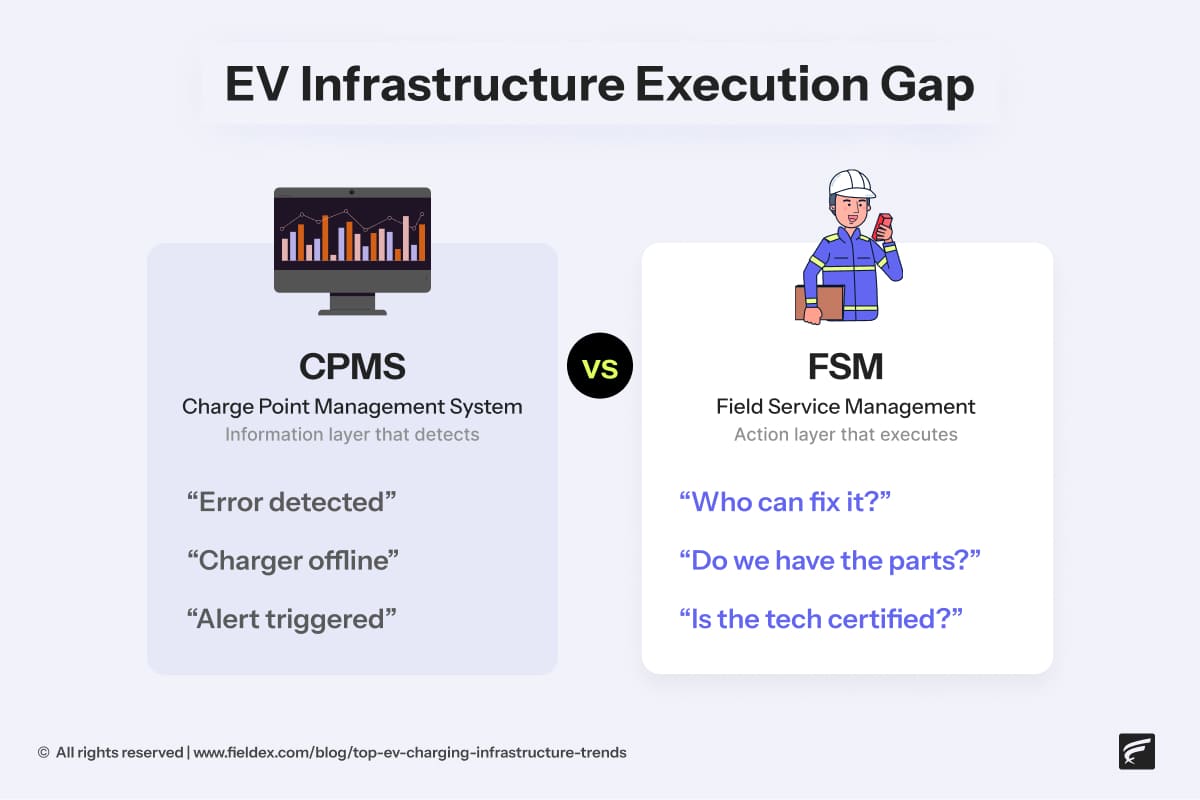
2. CPMS vs FSM: The great execution gap

Most operators start with a Charge Point Management System (CPMS). These are great for the digital stuff – billing, remote resets, and showing a green icon on a map. But a CPMS is fundamentally "hands-off”. It can tell you a charger is broken (eg "Error 404: Connector Lock Failure"), but it cannot manage the logistics of fixing it.

The trend now is the Action Layer. This is where Field Service Management (FSM) steps in to handle the "physical" complexity:
  • Certifications: Does the tech have the Electric Vehicle Infrastructure Training Program (EVITP) certification required for this specific site?
  • Inventory: Is the specific replacement cable actually in the van's stock, or are we about to waste a three-hour "truck roll"?
  • Safety: Did the tech complete a Lockout/Tagout checklist before opening a 350kW cabinet?

3. The MCS revolution: Megawatt charging for heavy-duty logistics

We’re finally moving past the ceiling for heavy-duty vehicles. The Megawatt Charging System (MCS) is moving into series production, delivering power levels up to 3.75 MW – roughly 10 times faster than current CCS2 standards.

  • The Impact: A truck can now charge from 20% to 80% in less than 30 minutes, fitting perfectly into a driver’s mandatory 45-minute rest break.
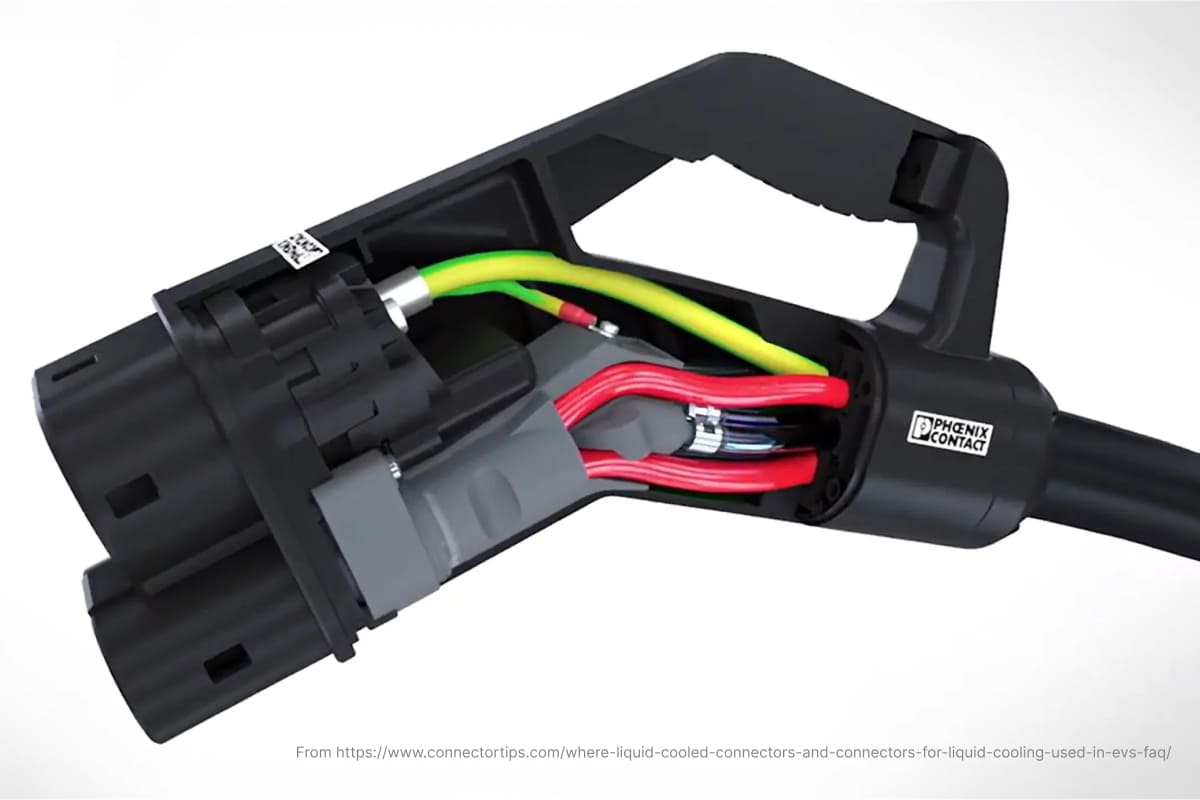
  • O&M Reality: MCS requires specialized liquid-cooled connectors to handle current levels exceeding 1,000 amps. You can't just send a residential electrician to look at these; you need a specialist who understands industrial-grade thermal management.

4. "Physical AI" and predictive analytics

Intelligence is creeping into every layer of the charging stack. We’re seeing a shift where predictive maintenance algorithms monitor charger telemetry to warn of impending faults days in advance.

  • The Goal: Improving charger availability and overall uptime while reducing operating costs.
  • Data Growth: The global EV charging station market is projected to reach $55.78 billion this year alone, driven largely by these software advancements.
  • Technician Shift: FSM software must now handle these automated alerts, turning "Predictive" data into "Dispatched" work orders instantly.

5. Site convergence (the "green umbrella" hubs)

Isolated fast chargers are being replaced by amenity-first hubs that feel more like rest hubs than refueling points.

  • Throughput: These hubs are essential for high-throughput electrified logistics and increasingly integrate on-site BESS (Battery Energy Storage Systems) and solar to avoid grid overloads.
  • Complexity: Managing a site of this scale requires balancing loads between solar canopies, high-capacity batteries, and dozens of ultra-fast chargers – a massive operational challenge.

6. V2G goes live: Your chargers just became cash machines

Forget the lab demos – Vehicle-to-Grid (V2G) and bidirectional charging are hitting fleet depots, with states like California and New York fast-tracking approvals. Fleets can now sell stored EV juice back to the grid during peaks, turning downtime into revenue via Virtual Power Plant (VPP) programs.

  • The Catch: V2G demands ironclad metering and grid event dispatching. One botched discharge cycle, and you're off the utility's approved list. (v2gnews)

7. Wireless charging: No more plug fumbles in the rain

Pads under parking spots at hubs and depots are ditching cables for inductive 11–20kW transfer – charge while you shop or sleep.

  • O&M Nightmare: Dust, water ingress, and coil misalignment kill efficiency fast. Maintenance now requires precision checks for under-pavement pads to ensure alignment remains within tolerance.

8. NACS lock-in: The plug wars end, standards wars begin

NACS (now J3400) is the de facto king, with 350kW+ ultra-fast stations standardizing on it. No more adapter roulette for the 33 million EVs projected to be on the road by 2030.

  • Reality Check: Legacy CCS ports need retrofits, and cable wear accelerates at these power levels. Mismanaged inventory for NACS-specific liquid-cooled spares means denied NEVI reimbursements if uptime isn't maintained. (driivz+1)

9. AI load boss: Keeping the grid from melting your site

Predictive AI isn't just fault-spotting; it's juggling solar, BESS, and 50 chargers in real-time via OCPP 2.0.1 – dodging overloads before they brown out the block.

  • The Grind: Alerts flood from cyber-secure protocols, needing instant tech dispatch with grid operator sync. Without bridging the digital-physical gap, you're playing whack-a-mole with cascading failures. 

How does FieldEx help manage complex green infrastructure operations

In the energy sector, "detection" is only half the battle. If a sensor indicates a battery module is overheating, that data is useless unless it triggers a precise chain of events. FieldEx bridges the gap between digital alerts and physical resolution by acting as the ‘execution layerfor your operations.

1. Unified workflow for converged sites

Modern energy sites are no longer "just solar" or "just EV". They are integrated hubs where solar panels, battery storage (BESS), and DC fast chargers coexist behind the same meter.

  • The FieldEx Solution: Instead of using three different apps for three different assets, FieldEx provides a single interface to manage the entire site. The same technician who services the solar inverter can follow a FieldEx checklist to inspect the EV chargers in the parking lot before leaving.

2. Guardrails for high-risk maintenance

Working on a 350kW charger or a utility-scale battery isn't like fixing a leaky faucet; it’s high-stakes, high-voltage work.

  • The FieldEx Solution: We use mandatory logic checklists. A technician cannot close a work order until they have uploaded proof of a successful "Lockout/Tagout" procedure or verified gas detection sensor functionality via a time-stamped photo. This ensures safety isn't just a policy – it's a hardcoded part of the workflow.

3. Regulatory readiness as a default

Compliance in 2026 is an "existential requirement”. Whether it’s meeting the 97% uptime for NEVI funding or maintaining the "digital passport" for industrial batteries under EU law, the paperwork is often more complex than the repair.

  • The FieldEx Solution: FieldEx automatically logs every part swap, serial number, and technician certification into an immutable asset history. When an auditor asks for a three-year maintenance trail for a specific battery rack, you generate it in seconds, not weeks.

Real-world scenarios: FieldEx in action

Scenario A: The 2.00 am charger fault

  • The Trigger: An EV charging station detects a "Connector Lock Failure" and sends an alert to the network operations center (NOC).
  • The FieldEx Action: FieldEx receives the API alert and automatically creates a work order. It checks the local inventory for a replacement cable and identifies "Tech Sarah" because she is the only one in a 30-mile radius with the required EVITP certification.
  • The Result: Sarah arrives with the correct part, follows a step-by-step safety guide on her ruggedized tablet, and the charger is back online in two hours – protecting the site's 97% uptime metric.

Scenario B: The BESS thermal alert

  • The Trigger: A Battery Energy Storage System (BESS) reports an anomalous temperature rise in Rack #4.
  • The FieldEx Action: Because BESS maintenance is often HVAC maintenance, FieldEx dispatches a specialized mechanical tech.
  • The Result: The tech uses FieldEx to access the "Asset Genealogy" and sees that Rack #4 had a coolant pump replaced six months ago. They quickly identify a faulty valve, replace it using van stock tracked in FieldEx, and complete the NFPA 855-compliant safety check to prevent a thermal runaway event.

Scenario C: Solar site "vegetation management"

  • The Trigger: A preventive maintenance (PM) schedule triggers a bi-annual site inspection.
  • The FieldEx Action: FieldEx’s PM Engine knows that excessive grass growth is starting to shade the panels.
  • The Result: A landscaping crew is dispatched via the same FieldEx app used by the electrical engineers, ensuring the site reaches its maximum yield.
Keen to see FieldEx in action? Book a free demo today, or simply reach out. We're here to help.

In conclusion: The "boring but reliable" path to success

The flashy marketing promises have been replaced by a demand for "boring software" – tools that are stable, offline-first, and obsessed with compliance. The winners won't be the ones with the prettiest apps; they’ll be the ones who can prove 97% uptime to the government while keeping their technicians safe and their spare parts organized.

Frequently asked questions

1. What exactly is the NEVI 97% uptime requirement?

It’s a federal mandate requiring each charging port to maintain an average annual uptime of over 97%. A port is "up" only when it successfully dispenses electricity.

2. Does "scheduled maintenance" count against my uptime?

Under NEVI rules, uptime is a strict measurement of availability, though certain exclusions like vandalism are generally allowed.

3. What is EVITP and do my technicians need it?

The Electric Vehicle Infrastructure Training Program (EVITP) is a certification for electricians. For projects supplying 25 kW or more, federal/state laws often require at least 25% of the crew to be EVITP certified.

4. Why isn't a CPMS enough for maintenance?

A CPMS is the "brain" – it handles billing and monitoring. An FSM is the "hands" – it manages physical labor, parts, and safety documentation.

5. What is the megawatt charging system (MCS)?

It’s a standard for heavy-duty vehicles supporting up to 3.75 MW of power, using liquid-cooled cables to manage extreme heat.

6. Is liquid cooling common in EV chargers?

Yes, it is essential for chargers delivering 350kW+ and the new MCS standard to prevent connectors from overheating.

7. What is a "digital battery passport"?

It is an EU requirement for a persistent digital record of a battery’s health, chemistry and maintenance history.

8. How does bidirectional charging (V2G) work?

Vehicle-to-Grid (V2G) allows EVs to receive power and send power back to the grid to stabilize demand and generate revenue.

9. What's the most common reason chargers fail?

While software glitches occur, most failures are physical issues like connector damage, cable wear, or cooling system leaks requiring technician intervention.

10. How does FieldEx ensure "safety as a default"?

FieldEx uses mandatory logic checklists that prevent work orders from closing until safety steps like Lockout/Tagout are verified with photos..

About the Author

Dashboard mockup

The FieldEx Team

FieldEx is a B2B field service management software designed to streamline operations, scheduling, and tracking for industries like equipment rental, facilities management, and EV charging, helping businesses improve efficiency and service delivery.

Complex operations simplified with one software.

No paperwork. No spreadsheets. No blindspots. Just one solution that simplifies your field service operations.
Header image